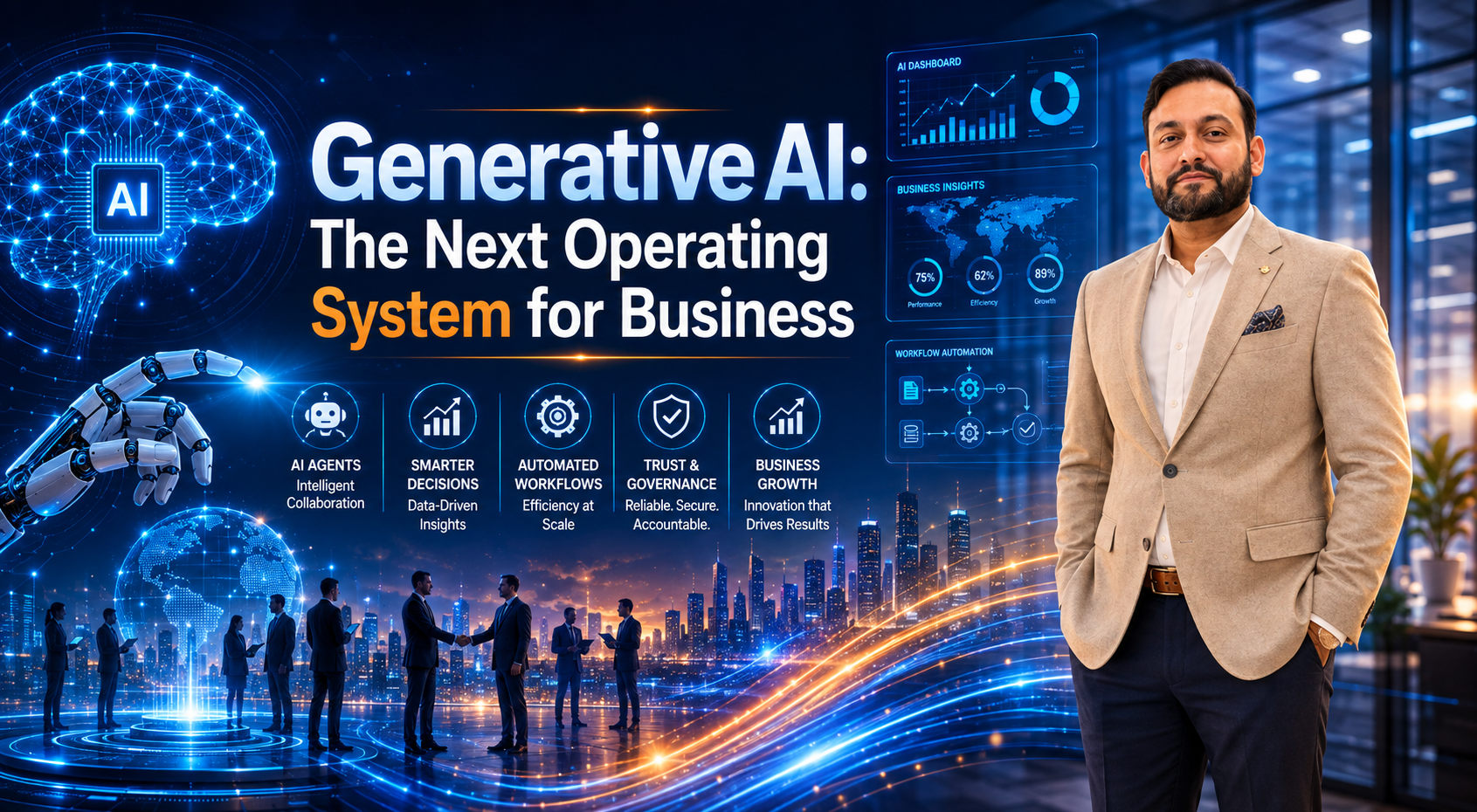
Generative AI: "The Next Operating System" for Business
By Shri Nitin Tiwari, Chairman, Aarav Global Group
Walking into the Future
Picture yourself stepping into the office in 2028. You don't open ten tabs or brief three teams. You simply say what you need: "a market entry plan", "a redesigned customer journey" etc.
Immediately, the AI agents begin working. They pull live data, draft options, flag risks, and wait for your judgment.
Let me assure you, this is not a distant dream. It's already happening in pockets of the businesses we work with today and I have personally witnessed it.
Just as autocomplete became second nature in email, agentic AI workflows will soon feel like the default way enterprises operate.
The Reality of 2026

As I can see, the adoption is everywhere, spending is rising, pilots are common. Yet the leap from experimentation to measurable impact remains elusive. In my perspective, the bottleneck isn't technology. Rather it's the plumbing of business: process redesign, data quality, governance, and talent.
Two shifts stand out:
- From Chatbots to Agents: Think of the difference between a calculator and Excel. One gives answers; the other executes multi-step tasks, updates records, and escalates only what needs human judgment.
- From bigger models to smarter ones: A Swiss Army knife is versatile, but a surgeon's scalpel is precise. Domain-specific AI systems are proving more reliable, cost-effective, and controllable than general models.
Essentials That Will Define the Next Phase
- Agents as teammates: In the next few years, I foresee that most knowledge work will involve AI agents as default collaborators. The winners will be those who redesign workflows around agents, not those who bolt AI onto broken processes.
- Specialisation beats scale: General models are powerful starting points, but the real value comes from systems tuned to a company's data, industry language, compliance needs, and brand voice.
- Human skills redefined: A constant question that I get asked is whether AI will replace humans. I just give them my favourite example: "GPS didn't eliminate drivers; it made their judgment more critical!", right?
- Trust sets the speed limit: Just as self-driving cars face adoption hurdles despite technical progress, AI will remain limited in high-stakes domains until organisations build reliability, provenance, and accountability into their systems.
- Infrastructure realities: Chips, energy, and data-centre capacity are the new bottlenecks. Like oil in the industrial revolution, energy economics will shape the AI revolution.
What I Am Predicting
By 2028, agentic workflows will feel as normal as autocomplete does today. True general intelligence remains further out than the loudest voices claim.
The practical decade ahead is about reliable, specialised, well-governed systems. The biggest advantage will go not to those with access to the largest models, but to those who redesign processes, data, and talent around AI and measure outcomes rigorously.
Risks We Must Manage
- Skill atrophy: Over-reliance on AI could weaken the expertise that makes AI effective today.
- Inequality: Firms that master AI collaboration will pull ahead, leaving others behind.
- Concentration risk: Dependence on a few providers creates strategic vulnerability.
These are not reasons to stand still. They are reasons I say to move with intention.
The Trail Ahead
Generative AI is the most powerful lever for growth and operational intelligence this generation will see. When paired with clear process redesign and human judgment, the results compound.
At Aarav Global Group, the future I want and the one we help our clients build is not about replacing human agency. It's about amplifying it: sharper decisions, faster learning, and organisations able to adapt at market speed.
That future is not automatic. It depends on the choices leaders make today and as far as I am concerned, I already have made one for my organisation!

Comments
No comments yet. Be the first!
Leave a Comment