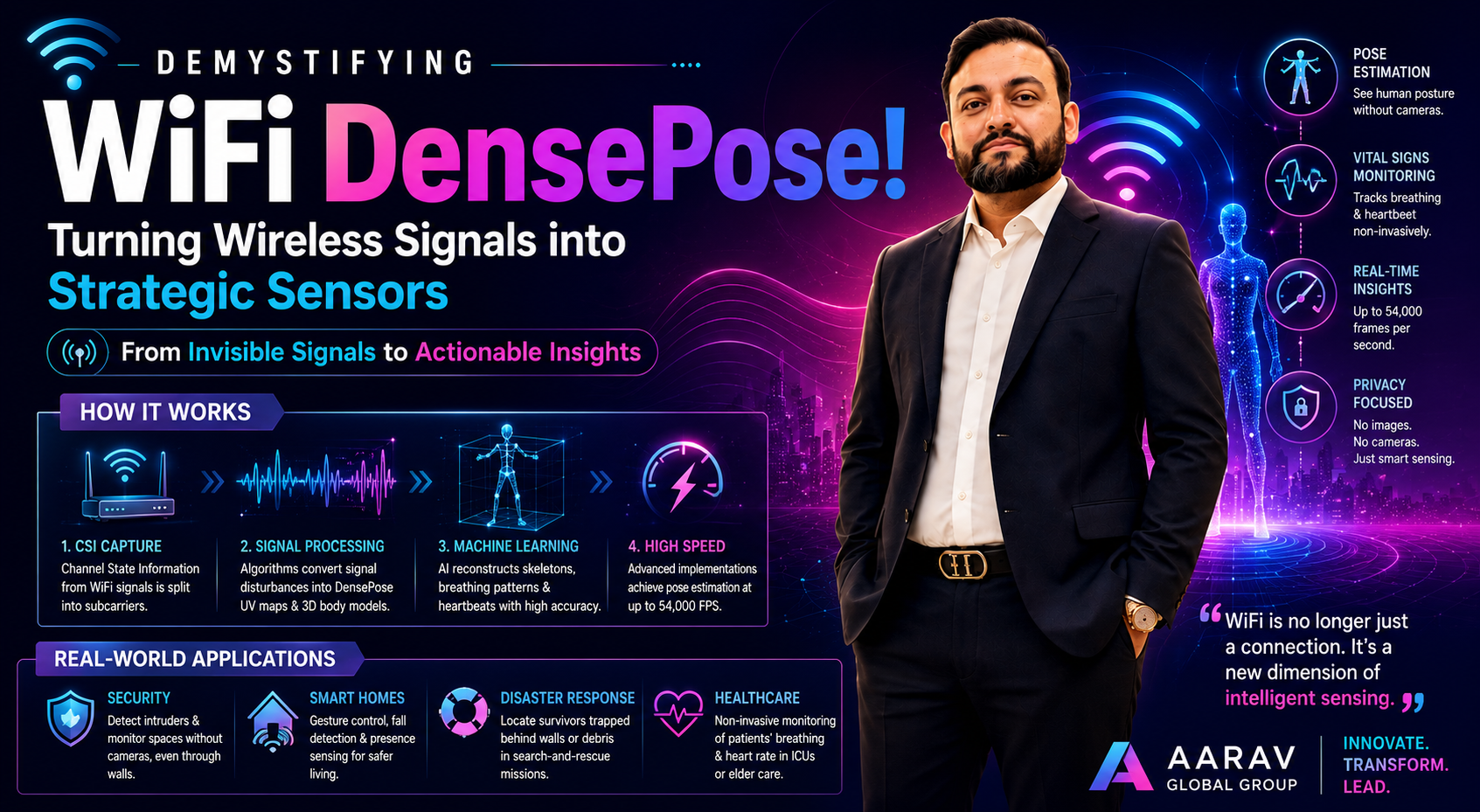
Demystifying WiFi DensePose!
Turning Wireless Signals into Strategic Sensors
By Shri Nitin Tiwari, Chairman, Aarav Global Group

Technology has always been my driving force, the spark that fuels my curiosity and keeps me constantly learning. I read voraciously, always searching for the next breakthrough that can expand my understanding. Recently, I stumbled upon something fascinating: WiFi DensePose.
Intrigued, I dove deep into the subject, guided by my boundless eagerness to master new skills. What I discovered was not just interesting, it was a glimpse into how wireless signals can be harnessed to map human movement with remarkable precision. And here's what I've uncovered so far......
In today's hyper-connected world, WiFi is no longer just a utility for internet access. Emerging research is transforming it into a powerful sensing tool, capable of detecting human presence, monitoring vital signs, and even reconstructing body posture without cameras or wearables. One of the most promising breakthroughs in this space is WiFi DensePose.
What Is WiFi DensePose?
WiFi DensePose leverages ordinary WiFi signals to estimate human body pose and monitor vital signs. Instead of relying on cameras or wearable devices, it interprets how human movement disturbs radio waves to reconstruct posture and detect subtle physiological changes like breathing and heartbeat.
In essence, it gives WiFi "X-ray vision", turning invisible signals into actionable insights about human activity.
How It Works
- Channel State Information (CSI): WiFi signals are split into subcarriers. Human movement alters their amplitude and phase.
- Signal Processing: Algorithms convert these disturbances into DensePose UV maps, 3D models of the body.
- Machine Learning: AI reconstructs skeletons, breathing patterns, and heartbeats with high accuracy.
- Speed: Advanced implementations achieve pose estimation at up to 54,000 frames per second, enabling real-time monitoring.
Real-World Applications
- Security: Detecting intruders or monitoring spaces without cameras, even through walls.
- Smart Homes: Gesture control, fall detection, and presence sensing for safer living environments.
- Disaster Response: Locating survivors trapped behind walls or debris in search-and-rescue missions.
- Healthcare: Non-invasive monitoring of patients' breathing and heart rate, especially in ICUs or elder care.
Why It Matters for Executives
For the organisations, WiFi DensePose is more than a technical innovation. It represents a paradigm shift in how organizations can leverage existing infrastructure for new capabilities:
- Cost Efficiency: Uses standard WiFi hardware, reducing reliance on expensive specialized sensors.
- Privacy Advantage: Unlike cameras, WiFi sensing doesn't capture visual images, making it less intrusive.
- Strategic Potential: Unlocks opportunities in healthcare, security, retail, and smart city initiatives.
Challenges Ahead
- Privacy Concerns: The ability to "see through walls" raises ethical and regulatory questions.
- Hardware Limitations: Full functionality requires CSI-capable devices, not just ordinary routers.
- Environmental Complexity: Crowded or multipath environments can reduce accuracy.
Conclusion
WiFi DensePose exemplifies how everyday technologies can be reimagined to solve complex problems. For executives, it's a reminder that innovation often comes from rethinking existing assets, in this case, the humble WiFi signal. As research matures, organizations that embrace such breakthroughs early will be best positioned to lead in healthcare, security, and smart infrastructure.
At Aarav Global Group, my team has already begun experimenting with WiFi DensePose, exploring how we can integrate this cutting-edge technology to deliver innovative solutions that potentially could help our global clients tackle complex business challenges. We are committed to staying ahead of the technology curve by constantly pushing boundaries to pioneer innovations!



Comments
No comments yet. Be the first!
Leave a Comment